
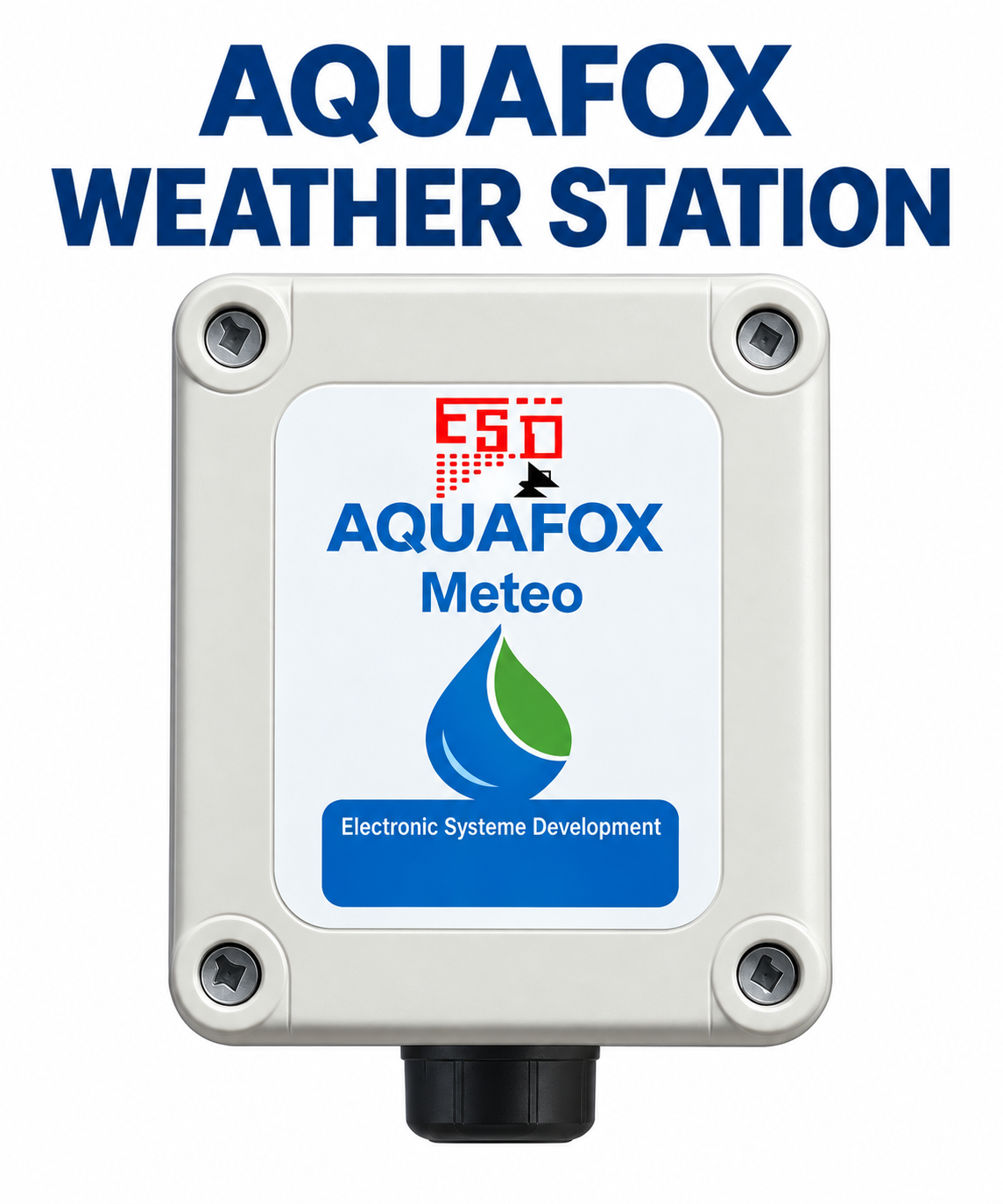
AquaFox Meteo Environmental Data Loggers
Low-power environmental data logging systems for meteorological, agricultural and remote monitoring applications.
Introduction
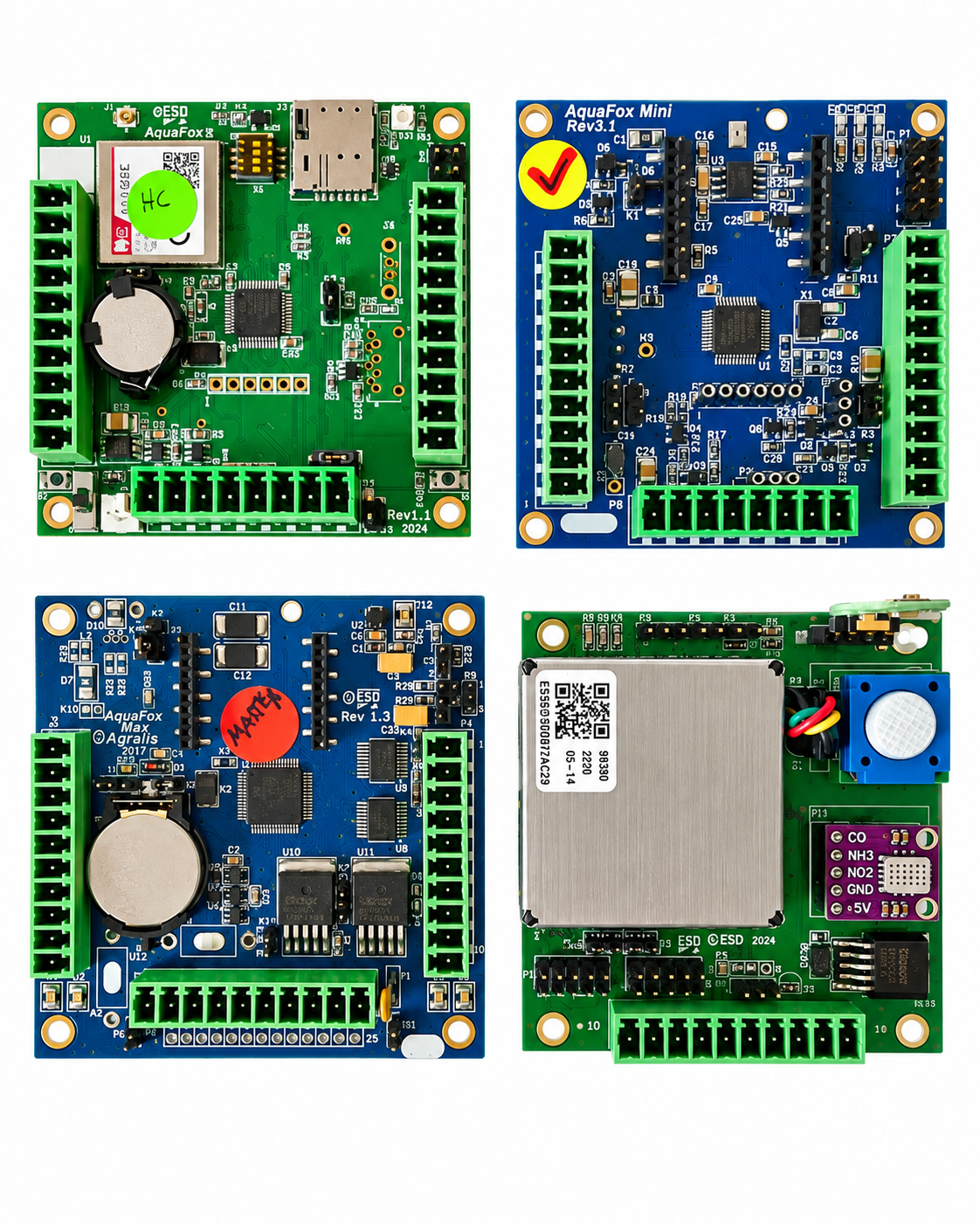
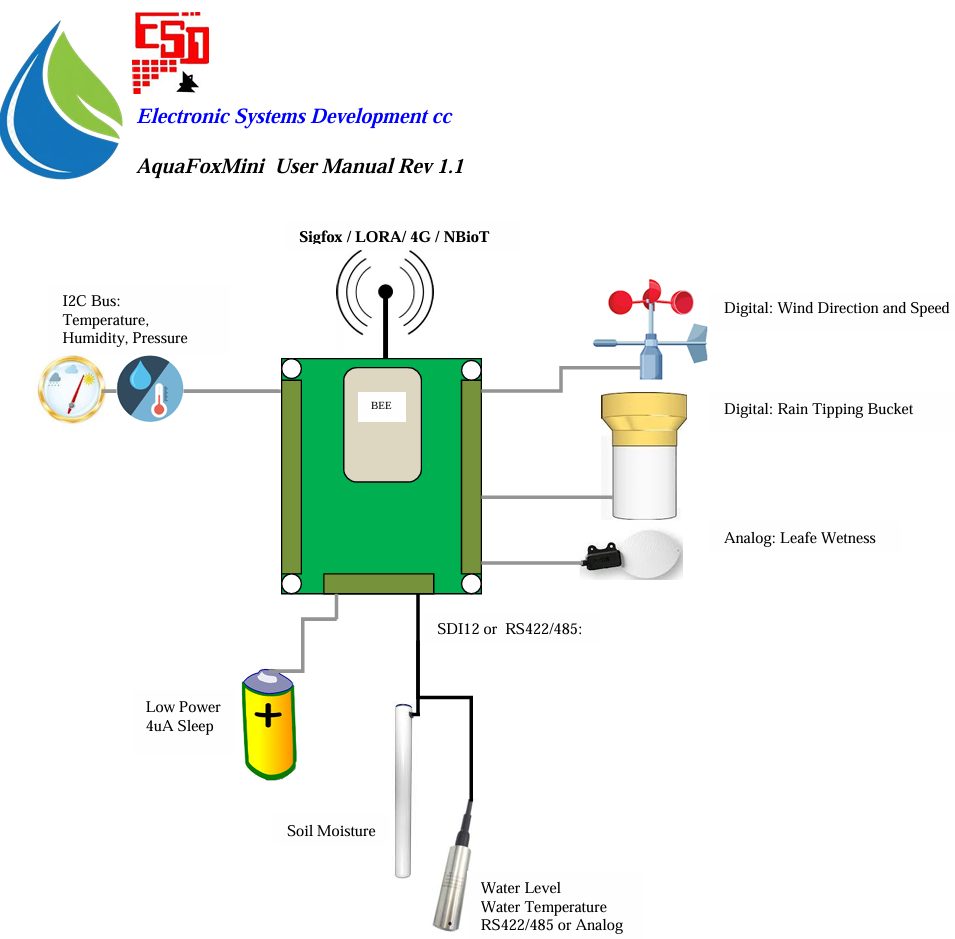
The AquaFox data logger is designed for
monitoring analogue and digital sensors
and transmitting measurement data through
Sigfox, LoRa or GSM/4G communication systems.
Measurements can also be stored locally
on an SD card.
Developed for battery-operated monitoring
applications, the AquaFox incorporates
several power-management modes to minimise
energy consumption between measurements
and data transmissions.
The logger can operate from a supply as low
as 3.3 V, with typical installations using
4.2 V or 7.2 V battery supplies.
Specifications and Features
- STM32L151 low-power microcontroller.
- Firmware updates using a three-wire SWD interface with J-Link.
- Multiple I/O connections including GPIO and four 16-bit ADC channels.
- Event input for rainfall tipping-bucket gauges or other event monitoring.
- High-speed counter input for applications such as wind-speed measurement.
- COM0 serial interface for terminal monitoring and configuration.
- Optional adapter board providing SDI-12 or RS422 communications.
- I²C interface for sensors and optional relay or GPIO expansion boards.
- 3 V to 12 V DC supply with integrated power management.
- Approximately 5 µA standby current in sleep mode.
- Switched probe power supply providing battery voltage or regulated 5 V, limited to 500 mA.
- Switched 3.3 V supply output, limited to 500 mA.
- Configuration through a terminal emulator connected to COM0.
- Onboard SD card for data storage.
- Battery-voltage monitoring selectable on internal ADC channel 0.
Low-Power Operation
Following startup, the logger provides a
20-second window for terminal commands
and configuration changes before entering
standby sleep mode.
In sleep mode, the logger typically draws
approximately 5 µA, allowing extended
operation from battery-powered supplies.
Ultra-Low-Power Event Counting
The AquaFox uses interrupt-driven wake-up
to record external events such as rainfall
tipping-bucket pulses.
When an event occurs, the microcontroller
briefly wakes, increments the appropriate
event counter and immediately returns
to sleep.
This event-processing operation typically
takes less than 100 microseconds, with
current consumption below 1 mA.
This approach minimises energy consumption
while maintaining accurate event counts
in remote battery-operated installations.
RTC Wake-Up and Data Transmission
The onboard real-time clock supports
periodic wake-up intervals in increments
of one second.
A typical application wakes the logger
every five minutes to collect measurements,
process stored events and transmit data.
The wake-up interval and associated actions
are configurable.
Power consumption during wake-up depends
on the operations performed.
For example, Sigfox data transmission
typically draws approximately 20 mA
for six seconds.
Extended Battery Operation
Battery life of up to two years is achievable with an appropriate lithium battery pack and low-power operating configuration. Actual battery life depends on battery capacity, sensor power requirements, measurement intervals, communications activity and environmental conditions.
Installation and Environmental Protection
The AquaFox logger PCB is not waterproof and does not have a protective conformal coating.
The unit must be installed inside a clean, weatherproof IP67 or IP68 rated enclosure. Suitable precautions must be taken to prevent exposure to moisture, condensation and environmental contamination.
For further information about the AquaFox data logger range, please contact ESD International .
← Back to all products